Tuesday, May 29, 2012

Monday, May 28 Kathmandu and Bhaktapur

Temple Bells above the Golden Gate at Durbar Square, Bhaktapur


Wood carving detail Bhaktapur


Three areas are on our schedule today: the old city of Bhaktapur, the Hindu temple at Pashupatinath, and the Buddhist stupa at Boudhanath. All three are part of the Kathmandhu Valley UNESCO World Heritage site. Bhaktapur is a city of 80 000 people about 13 km outside of Kathmandu. We walked from the tourist parking lot through red brick built houses. There were strands of garlic hanging from the upper floors. Wheat was laid out on blankets for drying.

Durbar Square is a focal point for interesting architecture. The intricacy of the wood carving is astounding. There is a golden gate that is also fascinating. The king of Bhaktapur lived  on this complex. There is a bathing pool with two huge pillars with Shiva’s snakes adorning the top. There are many Vishnavite temples in the area, some with erotic carvings. These are designed to illustrate the mutual male and female energy of the gods that is a significant part of tantric worship. There is a pottery square where you can see people firing pots. There are numerous Thanka workshops and shops. Also impressive is Taumadi Square which has a tall five-tiered temple, Siddi Laxmi temple.
Shiva shrines at Pashupatinah


Our second stop was the Hindu temple complex at Pashupatinath. There were cremation ghats with a few burnings going on. The river is much smaller than the Ganges. There were cattle in the river below the ghat. Among the series of shrines to shiva were some sadhus. Apparently there are imposters here who are looking to make money from pictures with tourists. We walked by the main temple but were not allowed to go inside. Along this path were a number of beggars who were suffering from Hansen Disease (Leprosy).

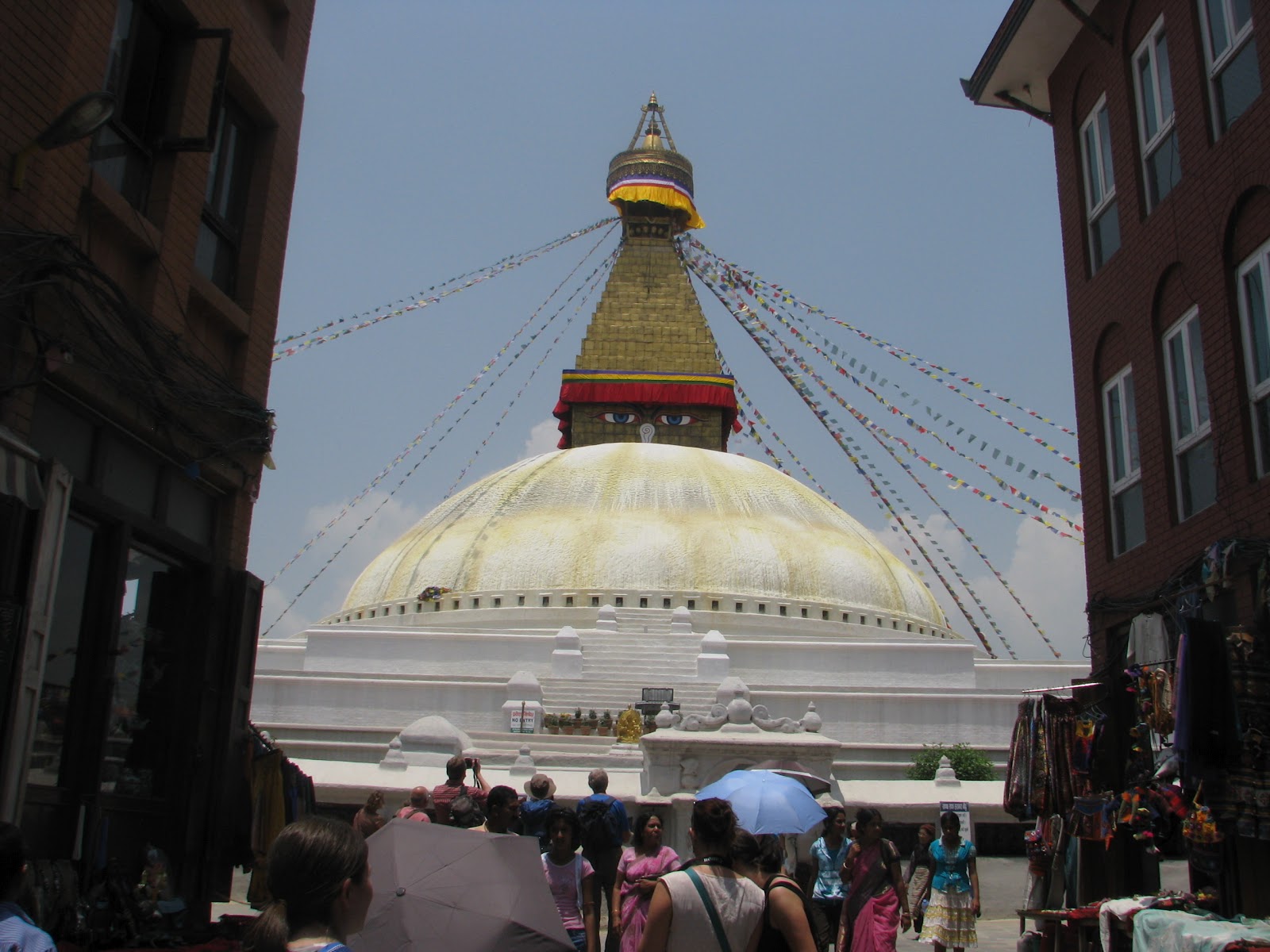
The third stop was the huge stupa at Boudhanath. This is the sight that is featured in films such as Little Buddha and calendars. It is a vast circular dome designed as a mandala from above. Surrounding the stupa a dozens of prayer wheels. There are a few very large ones. The area is lined with souvenir shops, Thangka studios and restaurants. We ate lunch in a rooftop restaurant overlooking the stupa.  By late afternoon we returned to the Hotel Shangrila.
Saturday, May 26 and Sunday, May 27, 2012


The group at Varanasi said farewell to the Sahi River Guest House and made our way to the airport. Despite having the longest security clearance we had experienced, we left for Kathmandu without difficulty. As the plane approached Nepal, we were able to see the mountains above the ground haze. Les and Sarah checked into the Shangri-la Hotel while Natalie and Nicki stayed closer to Thamel at the Hotel Silver Home. They explored Thamel before meeting up with Les and Sarah for Vietnamese food for dinner near the Shangri-La.  Natalie and Nicki are going to the same places and Les and Sarah and perhaps a bit more. Unless otherwise stated the rest of the blog will be written from Les’ and Sarah’s perspectives, at least until we meet to update the blog.

Sarah was ill, running a 103 degree fever with stomach pains. Visits by the house doctor and a trip to the clinic on Sunday gave her the correct medications. She layed low on Sunday. Les walked around the area in the afternoon. Kathmandu is calmer and more organized than Kolkata and Varanasi, at least to western eyes. Most people wear western-style clothing, most of traffic rules are obeyed and there’s less noise.  

Friday May 25, Varanasi, Sarnath, (Delhi)

Mulagandhakuti Vihara, Sarnath 
Prayer flags

This morning’s destination is Sarnath, the site of the Buddha’s first sermon in the Deer Park after his enlightenment at Bodh Gaya. Here he talked about the nature of existence, the Four Noble Truths, and the Eightfold Path.

The Mulagandhakuti Vihara has wonderful frescoes depicting the life of the Buddha. Nearby, there is a 1500 old stupa marking the believed site of the first sermon. We had intended to visit a Deer Park and archeological museum, however, both were closed today.

We were taken to the magnificent Kagyu Tibetan monastery. Boy monks were playing before lessons. The temple itself has a wonderful series of mandalas, including the Dhammachackra.

It was time for Jan, Jackie, and Michelle to head off for Delhi. Before heading home on Sunday, they would be visiting the Taj Mahal on Saturday. We hugged our farewells and then went on our separate ways.

In the evening Sarah, Natalie, Nicki and Les ventured towards old Varanasi. The heat, crowds and noise were intense. We beat a retreat to Broadway restaurant for dinner.  It was time for us to pack up at our hotel in preparation for our next step of our journey.

Sunday, May 27, 2012

Thursday May 24, Varanasi

Heading down the Ganges at 5:00 am

Orange fire from the burning ghats reflecting in the water. Jan and Michelle

Nicki on the Ganges

Aarthi

We wake before dawn to be taken down the river in a row boat. The early morning Ganges is the epitome of serenity. We see early morning bathers as well as those doing their morning ablutions. There are dozens of ghats—sets of steps running down to the water’s edge. They are usually associated with a temple, crematorium or a fort. We leave from Assi Ghat, the southernmost ghat. We also see people washing their clothes by slapping them against rocks on the riverside. Yogins practice their various stretches and strengthening techniques. Many pray in and beside the water.

A few of the ghats are prepared for cremations. There are stacks of logs and brush ready to be placed along the river. Bodies are placed on the logs and then amid prayers and chants. Then they are set on fire. After the site is reduced to ashes, they are placed into the Ganges. Devout Hindus believe that if they die and ashes placed in the Ganges, their sins are literally washed away. The Ganges (locally called Ganga) is a god who purifies. There is a quite beautiful story about how the Ganges River came down to earth from heaven.

After breakfast, a guide takes us to some of Varanasi’s significant temples. We are first taken to the new Golden Temple (new Vishwanath temple) on the campus of Banares Hindu University (BHU), the largest university campus in Asia. The temple has several shrines but most of the space is open area used for people to pray, talk, study or rest. There are wonderful sayings on the wall from the Bhagavad Gita, other parts of the Mahabharata, Ramayana, the Vedas, Upanishads, Puranas and the Dhammapada.

Our next stop is  the Monkey Temple, more properly known as thSankat Mochan temple. It is dedicated to Hanuman, the brave monkey-god hero of the Ramayana. Here you can pray before an image of Hanuman for to relieve your troubles. Upon entering the grounds, you pass through an avenue where dozens of monkeys frolic among the trees and fences of the compound.

The third temple is dedicated to the writer of the Hindi version of the Ramayana, Tulsi, who lived here while compiling this text. The entire text is inscribed on the walls of the temple.

The fourth temple is in old Varanasi; it is the old Golden Temple or Kashi Viswinath Temple, so called because of the vast amounts of gold on its dome. It is, perhaps, the most sacred of all the Varanesi temples. There is a tremendous crush of worshippers in narrow, alley-like streets. The security is tight because of conflict between extreme Hindus and Muslims. The crowds and demand for our passports defeat us. We settle for a close view of the dome from some steps in the alley.

The 44 degree temperature makes venturing out this afternoon difficult. Nevertheless, Sarah and Jan explore the ghats and some of the market areas away from the river. They encounter silk merchants, cows swimming in the Ganges, kids playing Ludo, and snake charmers.

In the evening we take to the river again. We accidentally row over a corpse in the river. The poor want a Ganges burial, but can’t afford the cremation fees at the ghats, so they place the dead in the river. Some other people such as the most holy and pregnant women are also placed into the river without cremation. We glide past the funeral pyres as dusk settles and dozens of bats zip around our heads. We moor alongside dozens of other boats to watch a worship ritual. Five men use bells, smoke and fire in a highly symbollic ritual called Ganga aarathi.

Varanasi, once called Kashi and then Benares, is one of the oldest cities in the world. Some Hindus believe that the city was founded by Shiva as a peaceful place for him to pray. Shiva’s dance at the end of time will take place here.


Wednesday, May 23 Delhi, Varanasi

Ganges at Asi Ghat, Varanasi
The area near the Delhi Hotel in Karol Bargh is a curious mix. It has a few hotels, hospitals, and car suplly shops. Our return tothe airport was much more straightforward than yesterday's adventure. The airport featured shops such as WH Smith, Marks and Spensers and the Body Shop.

As the plane descended into Varanasi, the pilot told us that the ground temperature was 44 degrees. At the terminal we negotiated our way through a flurry of porters and drivers to our cabs into the city. It was very hot, congested and dusty. As has been the pattern, our drivers found the hotel after a few false turns and requests for directions. The entrance to the Sahi River Guest House is not auspicious: you go along the ghat, turn up an alley, then through a side alley, up a couple of flights of stairs to the lobby of the hotel. The Sahi River View Guest House does indeed have a beautiful view of the Ganges. We ate at a pizzeria east of the hotel to make plans for the next day.


Saturday, May 26, 2012

Tuesday, May 22 Siliguri, Bagdogra, Delhi

After breakfast, we gathered for our last group reflection. Jane was staying here in Siliguri and would meet up with Jan, Michelle and Jackie on Sunday morning for their last flight home. At the gathering we expressed our gratitude for the wonderful learning experiences and shared some ideas for future trips. Mr. Aloke, Jane and Sr. Sabrina accompanied us to the airport where we said our goodbyes.

Delhi airport is very impressive--as good as any most of us had seen. We found our way to the pre-paid taxis and negotiated our price (350 rupees or $7) for each of the two cabs. The trip to the Hotel Metro Heights in Karol Bargh was an adventure. The heat in Delhi (41 degrees) was very challenging. even with the windows open the cabs (no A/C) felt like blast furnaces. The cab driver for Nicki, Jackie and Les drove 200 metres the wrong way on a divided highway to get to a propane gas filling station. We were asked to leave the cab while he refueled. With visions of the driver escaping with our luggage, we maneuvered into a position where we could block his way. Fortunately, our suspicions were unfounded.

Both drivers had difficulty finding the hotel and had to stop for directions several times. Our rooms were comfortable with A/C and good showers. We ate a rather insipid meal in the hotel restaurant. 

Friday, May 25, 2012

Monday, May 21 Darjeeling, Mirick, Siliguri

Chowrasta, Darjeeling
Looking up the Balason River valley
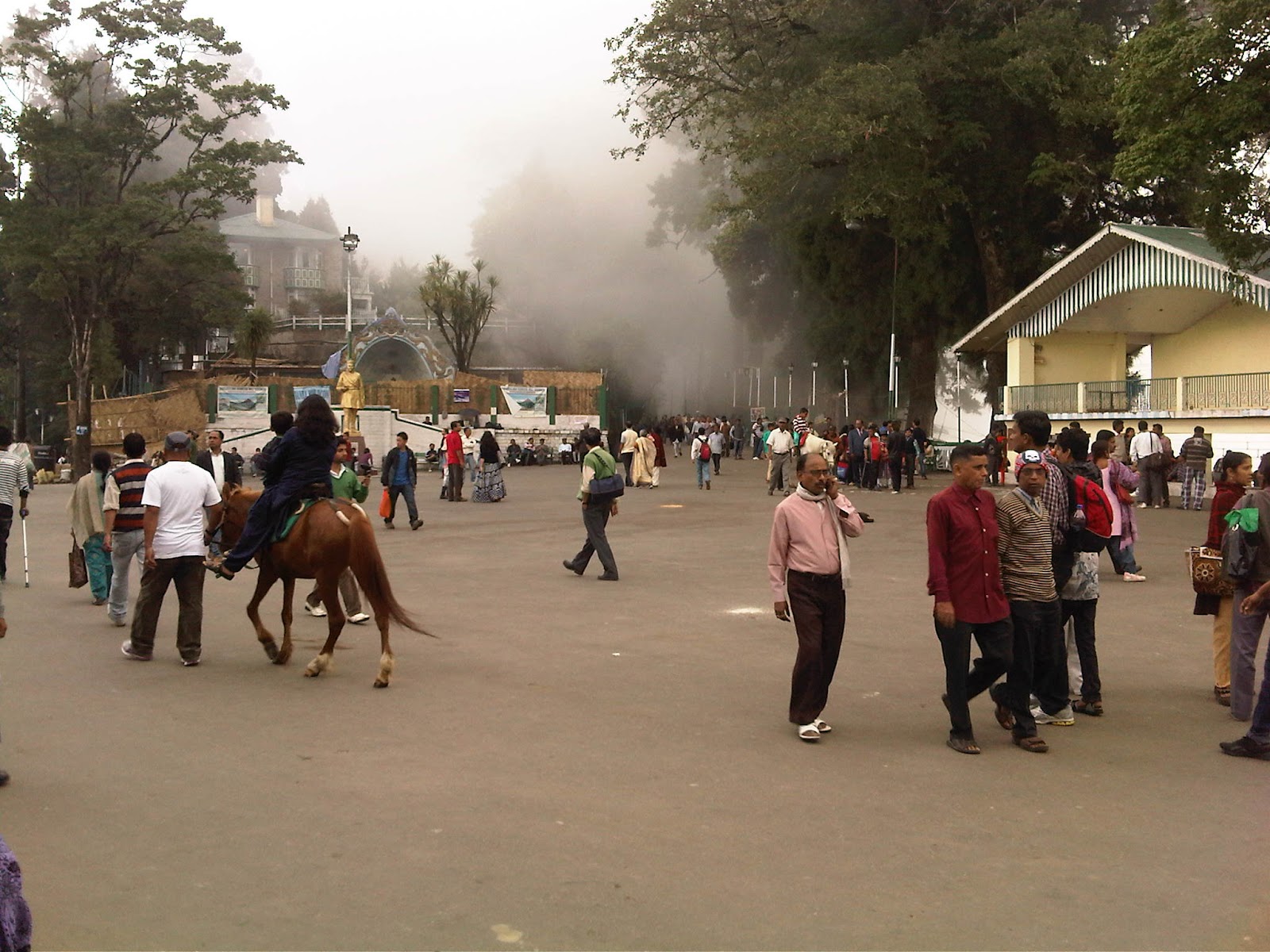
This morning was our last time to shop and say our farewells in Darjeeling. There was a heavy police presence because of an anticipated political protest. It was the second anniversary of a murder that had political overtones. many of the people of Darjeeling area are looking for more political autonomy. The government of West Bengal, which administers this area south to Kolkata is dominated by Bengalis whose culture, language and concerns are different from the Nepalis who are in the majority here. The separatist movement is looking for a separate jurisdiction called Gorkhaland. There were speakers in the area close to the assassination, but there was no trouble that we heard of.

We left in the early afternoon south to the Mary Ward Centre in Siliguri. Our two jeeps crawled through the Darjeeling traffic to Ghoum and then southwest towards Mirick. The winding road fell gently through groves of magnificent evergreens and tea plantations. Our views were obscured by low cloud, fog and then rain.

As we approached Mirick, we passed alongside the Nepalese border. The road wound down through tea plantations as the rain intensified. Mirick has one of the areas few lakes and a pink hospital! We had a short stop for tea here.

The final part of the road was a steeper drop to the plains. The clouds had lifted, giving us views up the Balason River valley. Our route took us very close to Panighata and then east beside the park we had visited two weeks earlier. By the time we arrived at the Mary Ward Centre it was dark. Sr. Monica and Sr. Sabrina were there to welcome us.

The Mary Ward Resource Centre is a relatively new facility devoted to helping the needy in the area. They promote safe migration to thwart human traffickers. Young women are particularly prone. They or their families will succumb to false offers of employment as nannies or family domestic help only to be sold into prostitution in various parts of Asia. The Centre also helps tea garden families and others break the cycle of poverty. Education is a major tool in their work.